
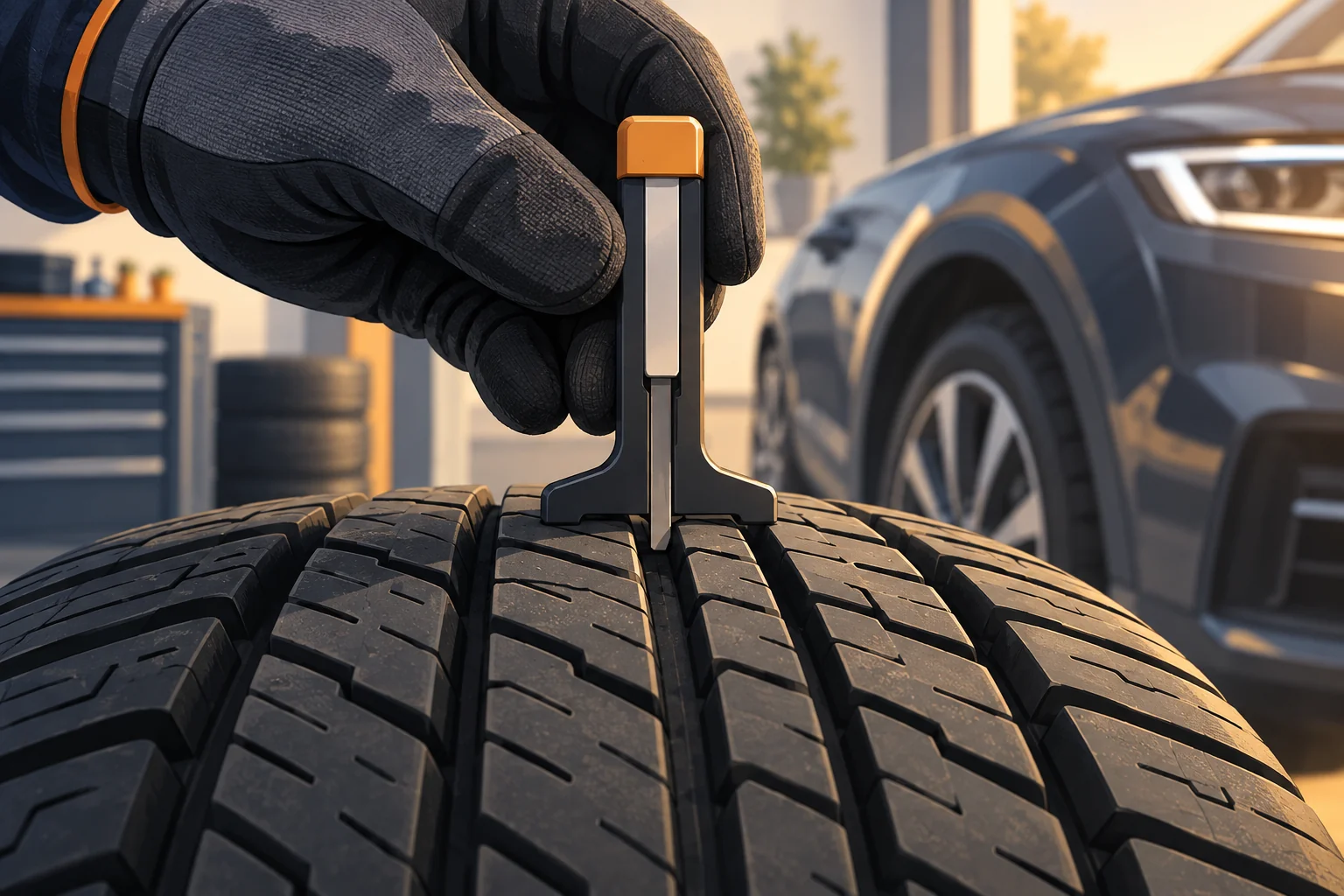
What the 1.6 mm rule actually covers
For cars, light vans and light trailers, the Highway Code states that tread must be at least 1.6 mm across the central three-quarters of the tread breadth and around its entire circumference. One good reading on the outside of a tyre does not establish that the whole tyre complies. The inner edge and positions hidden against the ground deserve attention too.
This is the minimum legal requirement for that vehicle category, not a promise that a tyre will perform like new in every condition. Nor does sufficient tread make a damaged tyre acceptable. A tyre with a bulge or another serious defect can need replacement even when its grooves are deep. This guide focuses on cars and light vans, not the different rules for every vehicle class.
How to make a useful measurement
Park somewhere level and safe, switch off the vehicle and use a tread-depth gauge according to its instructions. Take several readings across the relevant grooves and at different points around the tyre. Do not rest the measuring probe on a raised wear indicator, stone or other obstruction. Write down the lowest readings rather than choosing the most reassuring one.
If access is awkward, have a tyre professional check it. Do not crawl under a car supported only by its emergency jack. Looking at the front wheels with the steering turned can make some areas easier to see, but a quick look still cannot reveal the entire circumference. A workshop inspection is useful when wear is uneven or close to the limit.
Where the 20p test helps, and where it stops
The familiar 20p test uses the coin's outer band as a quick indication of groove depth. If the band is visible when inserted into a main groove, arrange a proper measurement. Repeat in several places. Treat this as a screening check, particularly when you do not have a gauge, rather than a precise certificate that the tyre is legal.
The coin does not measure internal damage, prove that every part of the tyre is compliant or tell you how many miles remain. If you are booking a long journey and the result looks marginal, measuring properly before departure is more useful than debating a photograph of the coin. A fitter can explain the actual readings and available replacement options.
Why one edge can wear before the rest
Tyres do not always wear evenly. Pressure problems, wheel alignment, suspension issues and the way the vehicle is used can contribute. Describe any pulling, vibration or recent impact when asking for an inspection. Replacing the worn tyre deals with its condition, but it may not correct the reason it wore unevenly.
Keep a simple record of readings by wheel position. For example, noting “front left: inner groove lower than centre” gives the technician a clearer starting point than “the tyres look old”. Do not diagnose alignment from a single photograph or assume balancing and alignment are the same service. Ask whether a separate workshop check is appropriate.
When should you plan a replacement?
The closer a tyre gets to the minimum, the less flexibility you have for further wear before replacement. Wet-weather grip is also affected by tread, tyre design and road conditions. Plan around the journeys ahead, rather than relying on an unverified estimate of how many miles a particular reading will last. No fixed remaining-mileage promise fits every vehicle and tyre.
Check again before a long trip or when your driving pattern changes. If a fitter recommends replacing above the legal minimum, ask them to explain the measurements and the reason. That lets you separate a legal requirement from a condition-based or preventative recommendation and make an informed decision without guessing.
Booking without surprises
Send the full tyre size and postcode when requesting prices. Mention how many tyres need attention and whether the fronts and rears use different sizes. Ask for the complete fitted price, including the items relevant to your vehicle, rather than comparing only the cost of the rubber. Stock and availability should be confirmed before you arrange your day.
Best Mobile Tyres can check availability for replacement fitting around Dudley, Brierley Hill and surrounding areas. If you are unsure whether the tyre can still be driven safely, say so before travelling. A mobile visit at a suitable location may avoid an unnecessary journey on a tyre whose condition has not yet been established.
This guide is general information, not a remote tyre inspection. If the vehicle or location is unsafe, stop driving and seek appropriate professional assistance.